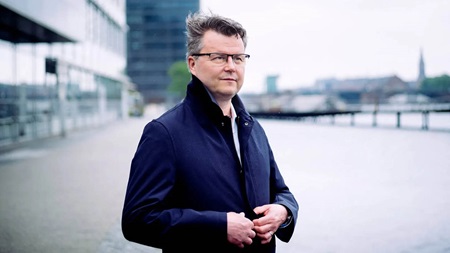
By Samu Slotte
Head of Sustainable Finance, Defence & Advisory
Many large companies across the Nordic region are implementing plans to transition their activities to lower their emissions. Other companies are scaling their low carbon business solutions to enable the transition of high emitting sectors.
At Danske Bank, we regard this not only as a responsible choice but as sound business judgement. Ultimately, investing in the transition is about building resilience, strengthening competitiveness, and driving long term profitability.

Three megatrends driving the energy transition
Recent headlines might suggest paralysis and a slowdown in the green transition and the electrification of our societies. However, the commercial drivers of the energy transition are embedded in the business environment and are not easily changed, even when public attention to climate change shifts amid geopolitical uncertainty.
We see three powerful trends:
- Energy security.
Underscored by geopolitical instability and resulting volatility in global fossil fuel markets, this agenda is a key focus area today. Events such as the Hormuz Strait crisis have highlighted how dependence on oil and gas can expose countries and companies to fragile global supply chains. Regions that are large net importers of oil and gas, such as China and Europe, are particularly motivated to reduce reliance on fossil fuel imports. - Competitiveness.
In most regions, renewables are now the cheapest form of energy, continuing to drive deployment of wind, solar and batteries. In Europe, electricity prices are often set by the cost of gas. With gas increasingly imported as Liquified Natural Gas ( LNG), electricity costs in Europe are structurally higher than in many competing industrial regions. Reducing reliance on this expensive LNG will help bring energy costs down. - Climate regulation continues to drive action in the real economy.
While the US may be taking a step backwards, the EU and Nordic governments are largely staying the course.
Together, these forces create strong, long-term incentives for countries and companies to shift from fossil energy towards renewable and low carbon alternatives.
Three megatrends driving the energy transition

Energy security

Competitiveness

Regulation
Decarbonisation of heating in buildings has also come a long way, not least due to extensive district heating networks in larger Nordic cities. We also continue to see investments in heavy industry as new technologies are deployed to reduce emissions. Decarbonisation of the transport sector is also set to continue.
In addition to sectors that need to transition, the Nordic region is characterised by a broad range of companies providing the technologies required for both local and global transition. These include renewable energy equipment manufacturers, electrification and energy efficiency solutions providers, critical minerals mining and refining as well as biofuel producers. These companies are set to continue to grow and often require significant capital to support that growth.
This is not to say that there are no challenges. In several sectors, the technologies required for decarbonisation are not yet fully matured. However, the notion of a broad standstill is not supported by what we see in practice.


We believe that all types of loan instruments, credit and guarantee facilities, as well as capital raising in bond and equity markets, can contribute to a company’s overall sustainable business model and transition strategy.
Samu Slotte
Head of Sustainable Finance, Defence & Advisory


The energy transition is capital intensive
Significant capital is needed to finance investments both in companies and industries undergoing transition and in those growing. This is where financial institutions and markets play a key role.
In the evolving landscape of sustainable finance, the traditional approach has primarily involved allocating funds to specific projects or activities through use of proceeds financing or sustainability linked loan facilities. These products play an important role in raising awareness and transparency around sustainability efforts, as well as facilitating access to dedicated sustainable investment funds across industries. However, they should not be viewed as the only ways financing can support a company’s decarbonisation efforts.
We believe that all types of loan instruments, credit and guarantee facilities, as well as capital raising in bond and equity markets, can contribute to a company’s overall sustainable business model and transition strategy. This depends on the company having a credible and actionable transition plan, which we regularly assess and review.
If our customers commit to their long-term transition, we commit to helping them manage the short-term challenges.
Samu Slotte
Head of Sustainable Finance, Defence & Advisory
For most companies, transition and growth journeys involve complex trade-offs between long term investment and short-term profitability. The energy transition will not be linear. It comes with risks related to technology, policy, markets and geopolitics, and will play out over a longer period than a typical business cycle.
The more challenging the sector, the longer the timeline, often spanning several decades. Moving too fast or too slowly both carry financial risks. Success therefore depends on maintaining a transition pace aligned with profitability, and on having a financial partner willing to stay the course, even in rough waters.
This also means that we as a bank need to take a long-term perspective beyond a business cycle and support our clients throughout the transition.
If our customers commit to their long-term transition, we commit to helping them manage the short-term challenges.