For businesses, this means reducing emissions from their operations or developing technologies that support the transition.
For policymakers, this means creating the right business conditions through clear regulation, targeted incentives and effective use of subsidies and taxation. This requires substantial investment, and the European Commission estimates that annual investment in the EU energy transition requires EUR 660-695 billion towards 20401.
In addition to climate policy targets, the climate transition is also driven by energy security concerns. Accordingly, the transition has in recent years become increasingly connected to the objectives of eliminating reliance on imported fossil fuels and protecting the economy from market volatility, e.g. in the form of increased energy prices triggered by geopolitical events.
Achieving a CO2-neutral economy depends on coordinated actions across society
A stable policy environment drives the transition
For individual businesses, aligning business models with net-zero ambitions is complex. Success depends on several external factors beyond the control of the businesses themselves, including infrastructure, technology, access to raw materials, regulation, consumer demand and financing. Success also depends on how and when these factors develop together. These conditions are shaped by both public and private action, often in combination.
Public policy is central in shaping the operating environment for businesses. Direction is set through policy tools such as taxation, subsidies and regulatory standards, which create incentives and influence demand.
In the Nordic countries, a stable and ambitious policy framework at both EU and national level has played a key role in the climate transition. National climate targets range from 55% to 70% reductions in greenhouse gas emissions by 2030, compared with the EU-wide target of 55%. This has provided predictability and clear incentives, thereby enabling Nordic businesses to plan and invest in the transition.
Clear and credible policy frameworks provide the confidence needed to invest
At a broader level, these policy frameworks have contributed to renewable energy becoming the main source of electricity consumption, and the electric vehicle market has surged, with battery electric vehicles now accounting for around 52% of new registrations in the Nordic countries, against an EU average of 15%2. The development has been supported by policy measures such as tax incentives and support for charging infrastructure, strengthening demand.
At EU level, the transition is supported by ambitious emission reduction targets and a range of regulatory frameworks. In addition to supporting the climate transition, they are an important factor in EU businesses’ competitiveness as the clean energy transition is a driver of growth. A central element of policy is the EU Emissions Trading System (ETS), which puts a price on carbon.
The predictability and transparency provided through the ETS have enabled businesses to make long-term investment decisions and commit to decarbonisation.

As an example, automotive manufacturers will have based their production on expectations of stronger demand for electric vehicles across the EU. This is partly linked to the extension of EU emissions pricing to transport, which will increase the cost of fossil fuel-powered transport and improve the relative competitiveness of electric vehicles.
Similarly, other industrial businesses aiming to electrify their processes are affected by regulation that shapes the competitiveness of low-carbon versus high-carbon products. The EU’s Carbon Border Adjustment Mechanism plays a role in this by putting a carbon price on carbon-intensive imports. This helps create a more level playing field for EU businesses and strengthens demand for low-carbon products such as low-carbon steel.
Because of the capital-intensive nature of the energy transition, the stability of such frameworks is essential.
Financial flexibility helps turn transition plans into actions
Many businesses have already made significant investments based on assumptions about the direction of policy.
Sudden changes that alter these assumptions - whether triggered by competitiveness concerns or to provide short-term relief for some businesses - can lead to additional costs for individual businesses as well as the wider economy, if the changes undermine trust in the long-term policy direction and erode the predictability that is essential for making investment decisions.
For the climate transition to succeed, and for the businesses driving the climate transition to succeed, it is imperative to have a stable and credible policy framework. Having such a framework provides confidence in the direction of policy and enables businesses and banks to commit capital and assume risk.

Banks as an enabler of the transition
Transforming business models to align with net-zero ambitions takes time, often many years, particularly across entire industries and value chains. We take these longer time horizons into account.
For large customers in high-emitting sectors, we include a transition risk assessment as part of a broader ESG risk assessment in the credit process.
We recognise that decarbonisation is particularly challenging in some sectors, and that each business will follow a different path.
To address this, we have developed an approach that enables us to continue financing such businesses - including those with critical roles in enabling value chains - provided they have initiated a transition and can demonstrate progress towards a credible transition plan. This includes setting emission reduction targets aligned with net-zero pathways, developing capital expenditure plans and articulating a strategy to deliver on those targets.
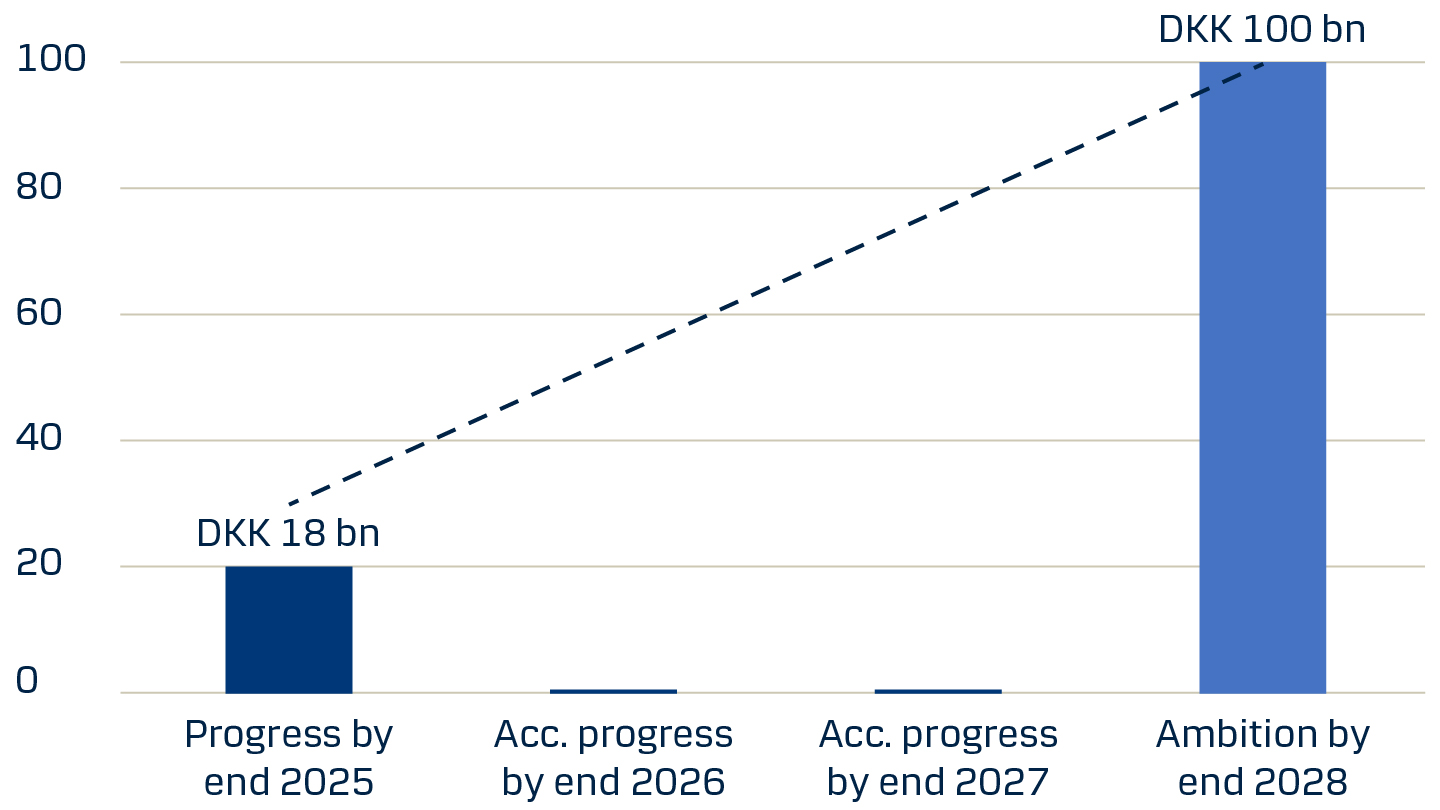
As part of this effort, we aim to provide DKK 100 billion in financing by 2028.
Credit exposure delta 2025-24 plus Danske Bank's share of primary market bond arrangements in 2025
2) European Energy Agency: Newly registered electric cars
Download this text as PDF
More on our approach
Transforming business models to align with net-zero ambitions takes time, often many years, particularly across entire industries and value chains. We take these longer time horizons into account.