Choosing the right framework
The Science Based Targets initiative (SBTi) is one of several voluntary frameworks available to companies seeking to structure and communicate their climate ambitions. Which framework is most relevant will depend on factors such as industry, business model, geographic footprint and stakeholder expectations.
There is therefore no single framework that suits every company, and many organisations use multiple frameworks to support different aspects of their transition efforts1. This article focuses specifically on the changes introduced in SBTi's Corporate Net-Zero Standard 2.0.
More than 1,000 Nordic companies have adopted SBTi
Since its launch in 2015, the Science Based Targets initiative (SBTi) has become one of the most widely used voluntary frameworks for corporate climate target-setting.
Today, more than 11,000 companies have validated targets through SBTi, representing over 40% of global market capitalization. More than 1,000 of these companies are headquartered in the Nordic region.
Companies with validated SBTi targets in the Nordics
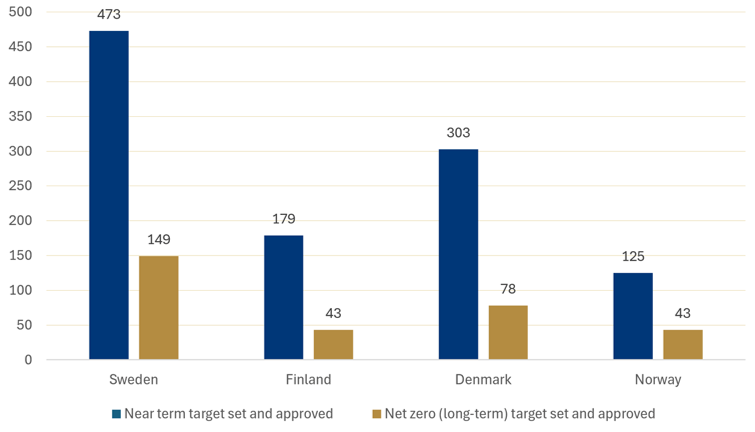
Note: "Targets Set" refers to companies whose near-term emissions reduction targets have been validated by SBTi and confirmed to be aligned with its methodology and climate science criteria. More information on the individual firms are available in the SBTi Target dashboard
SBTi 2.0 has arrived
Following two public consultations, SBTi launched its Corporate Net-Zero Standard 2.0 in June 2026, marking the first major revision of its net-zero framework. The updated standard incorporates recent climate science and introduces a more flexible approach argued to better reflect differences across sectors, geographies and business models.
A key change is the increased focus on delivery.
While the original standard primarily focused on target setting and validation, SBTi 2.0 places greater emphasis on transition planning and the practical actions required to reduce emissions. The revised framework places much greater emphasis on execution and expects companies to demonstrate how targets will be achieved through transition plans, governance structures, capital allocation and operational decisions.

What are the most significant changes in SBTi 2.0?
While the technical revisions in SBTi's Corporate Net-Zero Standard 2.0 are extensive, the broader shift is perhaps more important.
SBTi is evolving from a framework primarily focused on target validation towards one that places greater emphasis on implementation, accountability and real-world emissions reductions. The updated standard gives companies more flexibility in how they pursue decarbonization, while at the same time raising expectations around governance, transition planning and progress reporting.
The most important changes and implications are:
- From climate ambition to delivery
The most significant shift is that SBTi is no longer primarily focused on helping companies set climate targets. The revised framework places much greater emphasis on implementation and expects companies to demonstrate how targets will be delivered through transition plans, governance structures, capital allocation and operational decisions. - Transition plans and board accountability move to the forefront
Climate targets are expected to become more closely linked to business strategy. Companies must establish board-level oversight and develop transition plans that explain how targets will be achieved, including key actions, dependencies and implementation milestones. For larger companies, transition plans must also be publicly disclosed. - Different requirements for different companies
SBTi 2.0 introduces separate requirements for larger and smaller companies. Larger organizations face more extensive obligations, including mandatory Scope 3 targets, transition plans, assurance requirements and enhanced disclosures. Smaller companies benefit from greater flexibility, reflecting differences in resources and influence across value chains. The result is a more proportionate framework than in earlier versions. - Climate targets become more tailored to individual businesses
One of the more important changes is the increased flexibility in how companies set targets.
Rather than following a largely standardised approach, companies can now choose target-setting methods that better reflect their sector, business model, asset base and decarbonization opportunities. The underlying recognition is that the transition challenges facing a steel producer, a retailer and a technology company are fundamentally different and should not necessarily be addressed in the same way.

Most important changes
- From climate ambition to delivery
- Transition plans and board accountability move to the forefront
- Different requirements for different companies
- Climate targets become more tailored to individual businesses
- Scope 3 becomes more flexible and actionable
- Progress matters as much as target-setting
- A new "best efforts" approach
- Climate responsibility extends beyond direct emissions reductions
Scope 3 emissions remain a central part of the framework, but companies now have more options in how they address them. Rather than relying primarily on broad value-chain emissions reduction targets, companies can choose between several approaches, including supplier engagement targets, customer alignment targets and category-specific pathways.
The framework also allows companies to focus on the most material emissions sources within their value chains, helping concentrate resources where they can have the greatest impact. For many companies, this is likely to be one of the most significant practical changes in SBTi 2.0.
Validation is increasingly becoming the starting point rather than the end point. SBTi 2.0 introduces annual reporting, end-of-cycle assessments and expanded assurance requirements. Companies will increasingly be assessed on their ability to demonstrate progress, explain barriers and show how implementation challenges are being addressed, rather than solely on the ambition of their targets.
The revised framework explicitly recognises that companies do not control every factor influencing decarbonization. Rather than focusing solely on whether a target is achieved, greater attention is placed on whether management has used the levers available to them, addressed barriers and acted transparently when external constraints limit progress. This is an important acknowledgement of the practical challenges many companies face in areas such as technology availability, regulation and supply-chain transformation.
The revised framework also gives a more formal role to climate finance and high-integrity carbon credits through a voluntary recognition programme for ongoing emissions responsibility (OER). These mechanisms are positioned as complements to emissions reductions, not substitutes for them, but they reflect a broader view of how companies can contribute to climate action while progressing towards net-zero.
Taken together, these changes reflect a broader evolution in corporate climate management.
Climate targets are no longer viewed as stand-alone commitments but increasingly as part of business strategy, investment planning and operational decision-making. The emphasis is moving from target validation to delivery, accountability and measurable progress.

The transition to SBTi 2.0 will be gradual. Companies can continue to submit targets under Version 1 until the end of 2027, while organisations with existing targets are expected to transition to the new framework during their next target-setting cycle.
Regardless of whether a company has adopted SBTi, the revised standard reflects a broader trend: climate ambitions are increasingly expected to be supported by credible transition plans, governance structures and evidence of progress.
For companies already working with SBTi, this is a good opportunity to assess whether governance, reporting processes and transition plans are fit for the new requirements. For companies that have not adopted SBTi, the framework may serve as a useful benchmark when evaluating climate ambitions, transition planning and stakeholder expectations.
Ultimately, the most important message from SBTi 2.0 is that climate targets create value only when they influence business decisions. The companies likely to be best positioned for the transition will not necessarily be those with the most ambitious targets, but those most capable of turning ambition into action.
1) Danske Bank participates in several voluntary sustainability and climate initiatives, including the UN Principles for Responsible Banking, Net-Zero Banking Alliance, UN Global Compact, Poseidon Principles, Net-Zero Asset Owner Alliance, Net Zero Asset Managers Initiative etc. More details of Danske Bank’s climate targets for lending and investments are available on danskebank.com/sustainability