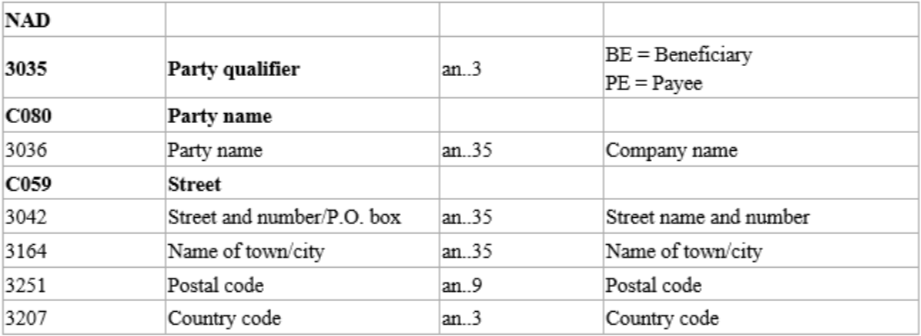
Region-specific guidelines
-
Swedish domestic payments
Changes to the timeline: As outlined in the timeline update above, implementation timelines may vary by payment scheme and market. Customers should continue preparing to use structured or hybrid postal addresses. If an address does not follow the rules once the requirement takes effect, it will be removed and the payment will be sent without an address.
An address is still optional in Swedish domestic payments. But if provided, it must be either:
-
Structured address (preferred)
- Mandatory: 'Town name' and 'Country'
- 'Address line' not allowed
- Use other structured elements (street, postcode, etc.) where possible
-
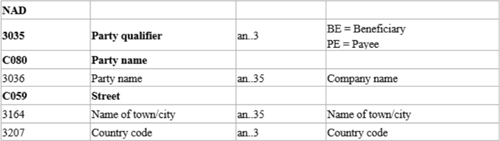
Hybrid address
- Mandatory: 'Town name' and 'Country'
- Up to two 'Address line' fields may be used (for example, street name or building number)
Please note that ‘Town Name’ and ‘Country’ must not be duplicated in the unstructured address lines.
We recommend customers in the region to use the ISO 20022 XML (pain.001) format and switch to structured or hybrid postal addresses for Swedish domestic payments.
-
Structured address (preferred)
-
Cross-border (SWIFT) payments
Changes to the timeline: As outlined in the timeline update above, implementation timelines may vary by payment scheme and market. Customers should continue preparing to use structured or hybrid postal addresses. If an address does not follow the applicable rules once the requirement takes effect, the payment may be rejected or delayed.
An address is still optional in cross-border payments. But if provided, it must be either:
-
Structured address (preferred)
- Mandatory: 'Town name' and 'Country'
- 'Address line' not allowed
- Use other structured elements (Street, Postcode, etc.) where possible
-
Hybrid address
- Mandatory: 'Town name' and 'Country'
- Up to two 'Address line' fields may be used (for example, street name or building number)
Please note that ‘Town name’ and ‘Country’ must not be duplicated in the unstructured address lines.
Payments with only unstructured address fields may be rejected or delayed once the revised requirement takes effect.
We recommend that you review your payment systems and get ready to use structured or hybrid addresses for all relevant Danske Bank payment channels. Where an address is required, include at least town name and country code.
For some countries, the beneficiary address must be included in the payment. In such cases, the address must be in the structured or hybrid format. See the list of countries in the Q&A section below.
-
Structured address (preferred)
-
SEPA payments
Changes to the timeline: As outlined in the timeline update above, implementation timelines may vary by payment scheme and market. Customers should continue preparing to use structured or hybrid postal addresses. If an address does not follow the rules once the requirement takes effect, it will be removed and the payment will be sent without an address.
An address is still optional in SEPA payments, unless the payment is to Serbia or North Macedonia, where a beneficiary address is mandatory.
If an address is provided, it must be either:
-
Structured address (preferred)
- Mandatory: 'Town name' and 'Country'
- 'Address line' not allowed
- Use other structured elements (Street, Postcode, etc.) where possible
-
Hybrid address
- Mandatory: 'Town name' and 'Country'
- Up to two 'Address line' fields may be used (for example, street name or building number)
Please note that ‘Town name’ and ‘Country’ must not be duplicated in the unstructured address lines.
We recommend customers in the region to use the ISO 20022 XML (pain.001) format and switch to structured or hybrid postal addresses for SEPA payments.
-
Structured address (preferred)
-
SEPA Direct Debit
Changes to the timeline: As outlined in the timeline update above, implementation timelines may vary by payment scheme and market. Customers should continue preparing to use structured or hybrid postal addresses. Transactions may be rejected once the revised requirement takes effect if an address does not follow the applicable rules.
For SEPA Direct Debit via files
- For transactions to non-EEA countries, the debtor’s address must be included. For transactions to EEA countries, the debtor’s address is not required.
- Debtor (payer) and creditor (beneficiary) addresses must be provided in either the structured or hybrid format.
-
Structured address (preferred)
- Mandatory: 'Town name' and 'Country'
- 'Address line' not allowed
- Use other structured elements (street, postcode, etc.) where possible
-
Hybrid address
- Mandatory: 'Town name' and 'Country'
- Up to two 'Address line' fields may be used (for example, street name or building number)
Please note that ‘Town name’ and ‘Country’ must not be duplicated in the unstructured address lines.
We recommend that you switch to the latest version of the pain.008 file format for SEPA Direct Debit. When you do so, there will also be changes to the pain.002 status file format for SEPA Direct Debit and the camt.055 file format for cancellations.
For SEPA Direct Debit payments created in District
The 'Edit debtor' screen is now available in District. Please use it to update debtor addresses to the structured format.
Debtors without a structured address will not appear in the mandate selection dropdown menu when you create a collection.
-
Polish high-value domestic payments
Changes to the timeline: As outlined in the timeline update above, implementation timelines may vary by payment scheme and market. Customers should continue preparing to use structured or hybrid postal addresses. If an address does not follow the applicable rules once the requirement takes effect, the payment may be rejected.
An address is still optional in Polish high-value domestic payments. But if provided, it must be either:
-
Structured address (preferred)
- Mandatory: 'Town name' and 'Country'
- 'Address line' not allowed
- Use other structured elements (street, postcode, etc.) where possible
-
Hybrid address
- Mandatory: 'Town name' and 'Country'
- Up to two 'Address line' fields may be used (for example, street name or building number)
Please note that ‘Town name’ and ‘Country’ must not be duplicated in the unstructured address lines.
For payments of PLN 1,000,000 or more, the country-specific formats PLI/PLE cannot be used, as they only support unstructured addresses. Such payments will be rejected. Exceptions are payments of PLN 1,000,000 or more to Tax Revenue Offices (TAX) and The Social Security Office (ZUS), which are processed via low-value domestic clearing. Such payments can still be sent in the PLI/PLE. For low-value payments of less than PLN 1,000,000, the PLI/PLE formats can still be used until around 2028.
We recommend customers in the region to use the ISO 20022 XML (pain.001) format and switch to structured or hybrid postal addresses for Polish domestic payments.
-
Structured address (preferred)
-
CHAPS payments, United Kingdom
Changes to the timeline: As outlined in the timeline update above, implementation timelines may vary by payment scheme and market. Customers should continue preparing to use structured or hybrid postal addresses. Payments may be rejected once the revised requirement takes effect if an address does not follow the applicable rules.
An address is still optional in CHAPS payments. But if provided, it must be either:
-
Structured address (preferred)
- Mandatory: 'Town name' and 'Country'
- 'Address line' not allowed
- Use other structured elements (street, postcode, etc.) where possible
-
Hybrid address
- Mandatory: 'Town name' and 'Country'
- Up to two 'Address line' fields may be used (for example, street name or building number)
Please note that ‘Town name’ and ‘Country’ must not be duplicated in the unstructured address lines.
We recommend customers in the region to use the ISO 20022 XML (pain.001) format and switch to structured or hybrid postal addresses for CHAPS payments.
-
Structured address (preferred)
-
Danish domestic instant (express) payments
Changes to the timeline: As outlined in the timeline update above, implementation timelines may vary by payment scheme and market. Customers should continue preparing to use structured or hybrid postal addresses. If an address does not follow the rules once the requirement takes effect, it will be removed and the payment will be sent without an address.
An address is still optional in Danish domestic instant (express) payments. But if provided, it must be either:
-
Structured address (preferred)
- Mandatory: 'Town name' and 'Country'
- 'Address line' not allowed
- Use other structured elements (street, postcode, etc.) where possible
-
Hybrid address
- Mandatory: 'Town name' and 'Country'
- Up to two 'Address line' fields may be used (for example, street name or building number)
Please note that ‘Town name’ and ‘Country’ must not be duplicated in the unstructured address lines.
We recommend customers in the region to use the ISO 20022 XML (pain.001) format and switch to structured or hybrid postal addresses for Danish domestic instant (express) payments.
-
Structured address (preferred)
-
Danish domestic payments, DKK batch
Changes to postal address requirements are expected from April 2027. Details will be provided later.
-
Norwegian high-value payments via NBO
From March 2027, unstructured postal addresses will not be accepted. If an address does not follow the rules below, it will be removed and the payment will be sent without an address.
An address is still optional in Norwegian high-value domestic payments. But if provided, it must be either:
-
Structured address (preferred)
- Mandatory: 'Town name' and 'Country'
- 'Address line' not allowed
- Use other structured elements (street, postcode, etc.) where possible
-
Hybrid address
- Mandatory: 'Town name' and 'Country'
- Up to two 'Address line' fields may be used (for example, street name or building number)
Please note that ‘Town name’ and ‘Country’ must not be duplicated in the unstructured address lines.
We recommend customers in the region to use the ISO 20022 XML (pain.001) format and switch to structured or hybrid postal addresses for Norwegian high-value domestic payments.
-
Structured address (preferred)
-
Norwegian domestic payments
There are currently no changes to Norwegian domestic payments. Address information included in payment files is not forwarded with the payment, and this will remain the case for the time being.
The Norwegian payment sector is considering future changes to how address information is handled. If new rules are introduced that affect Norwegian domestic payments, Danske Bank will inform customers in due time.